
Diversity and Identity are closely related. In this article, I examine the nature of identity-related terminology and explain why you don’t need to have imposter syndrome when using identity-related terms.
Aspects of identity
It is important to note that when we talk about identity, we tend to focus only on specific aspects which, when put together, form the actual identity of a person. This is self-evident since a description of an entire identity could only be described by naming that person, given that we are all individuals with different identities.
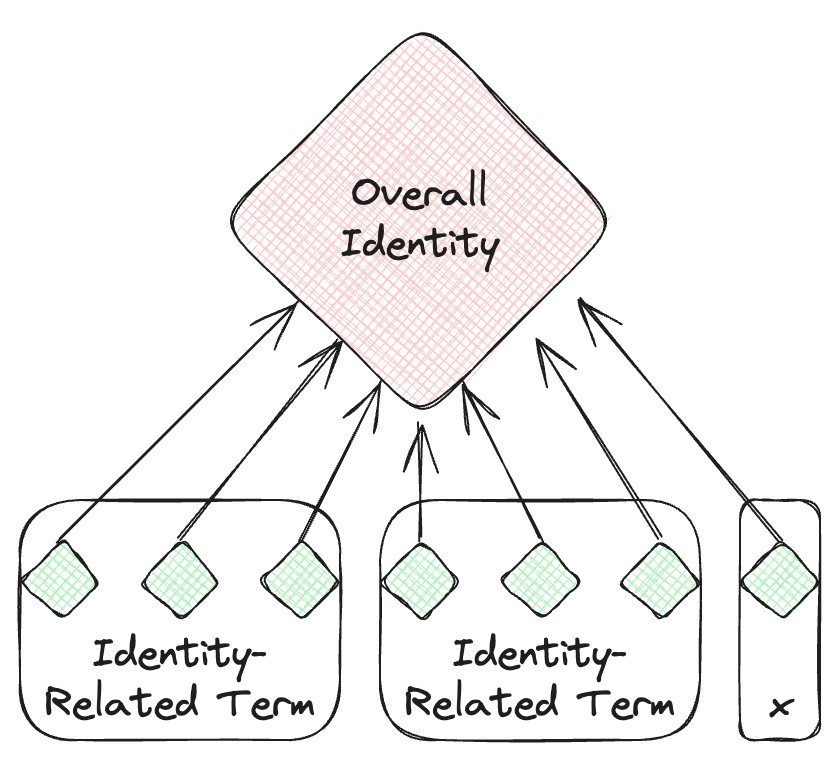
As identity is complex, and these different aspects can and do intertwine, inspection of these aspects can only be descriptive. By descriptive, I am referring to the fact that you can’t really describe identity well in a bottom-up approach, where the overall identity gets described by the sum of its parts. Instead, terminology related to identity can only truly be applied top-down
, describing that a whole identity matches a term of identity closely enough that it can validly be applied.
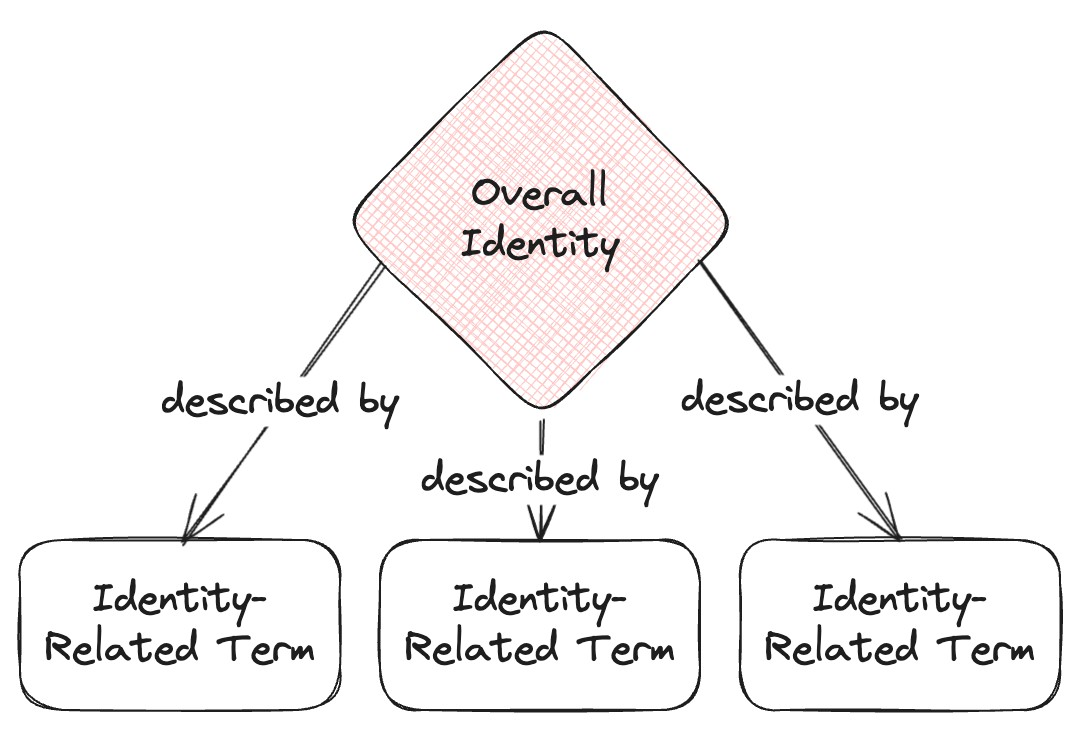
Irrelevance of Cause
Having established that any term that we might identify with
can only be a description based on looking at our identity as a whole, the cause of the singular aspect we create terminology around and might, therefore, identify with
, becomes entirely irrelevant. It could only be relevant if that aspect could be viewed in an isolated causal way, which is not feasible.
When I was questioning if I was trans, I spent a lot of time considering the cause of various aspects that made me believe I was trans. I wondered whether these aspects could be explained away
by my autism. I was searching for a validation of my potential identity-related discovery in a causality. A causality I could never find. Because I failed to realize that identity cannot work in a math-like manner, where
\[\text{autism}+\text{trans}+x=\text{Zuri.}\] Instead, I am trans because the definition of that term matches closely enough with the identity of Zuri
. My identity. It does not matter if my being trans
is the same (with the same causes) as another person’s. Either way, the fact that the common definition of trans
matches Zuri
closely enough makes it so that it, as a term, can be validly applied.
Therefore, I suggest that we consider aspects of identity not as puzzle pieces
but more as abstracted descriptions of a more complex system. This is similar to the way physics has coined terminology like force, impulse, or energy to describe the world around us. For example, the gravitational force isn’t a puzzle piece of nature. It is a description that fits what we see around us well enough for most purposes. And for some purposes (like relativistic effects of mass), it ceases to be precise enough, which is when we need new, more precise terms. These terms, however, take nothing away from the validity of the original description, since the new terms, too, are merely descriptive.
Irrelevance of Permanence
Interestingly, if the cause doesn’t matter, neither does the permanence.
Because if we cannot pin down a point of origin, we cannot determine whether the aspects of our identity that lead us to identify with a term will stay the same forever.
Now, don’t get me wrong: I don’t believe my identity will change in a way where being autistic
(or trans, for that matter) won’t apply to me anymore. This is also backed by scientific evidence. But this is nothing more than an educated guess, based on probability and statistics. And since I have already shown that searching for absolute causality behind aspects of our identity is futile, an educated guess is all it can ever be.
Note that I’m specifically referring to these labels as descriptions of identity. Outside the realm of identity, for example for a medical diagnosis, it is, of course, possible and useful to look into aspects like permanence. But for example, with autism, even with the diagnosis, one doesn’t necessarily have to see autism as an integral part of one’s identity (even if many do), meaning we can view its usage as a description of identity separately.
Conclusion
So while the questions of permanence (and cause, for that matter) are, due to our human nature, interesting to us, they have no influence on how we can use identity-related words or the validity of identification with these terms. The most validity that an identity-related term can have is the decision of a person that it applies to themselves1 at a specific stage in their lives.
Some might argue that this removes any value from these words. They could argue that if there is no causality associated with the words and no unambiguous definition, there is no value in it. But I would disagree. The value of such terminology remains the same: we can articulate aspects of our identity and potentially (if we want to) connect to others who share these aspects. We can seek help if we struggle with aspects of ourselves that are described closely enough by the term.
It also helps me deal with the imposter syndrome often associated with describing our identity with specific terms (Am I trans enough to call myself that?
). Having this terminology describe ourselves well enough presently is all the validation we can ever hope to achieve and, therefore, all the validation we need to be allowed
to use the term.
Footnotes
I want to note that I specifically say
person […] applies to themselves
since it is impossible to sufficiently know another person’s identity to determine if a term truly applies. We sometimes have to make assumptions for the sake of communication (we should be careful with such assumptions), but the final call can only be up to the specific person.↩︎
Reuse
Citation
@online{klaschka2024,
  author = {Klaschka, Zuri Nimca},
  title = {Identity {(English)}},
  date = {2024-08-13},
  url = {https://therian.blog/posts/2408-identity/},
  langid = {en},
  abstract = {An article about identity that originally appeared on my
    old website that is no longer online. Since I referenced the article
    here, I wanted to make sure it persists, and have therefore
    republished it, here.}
}